
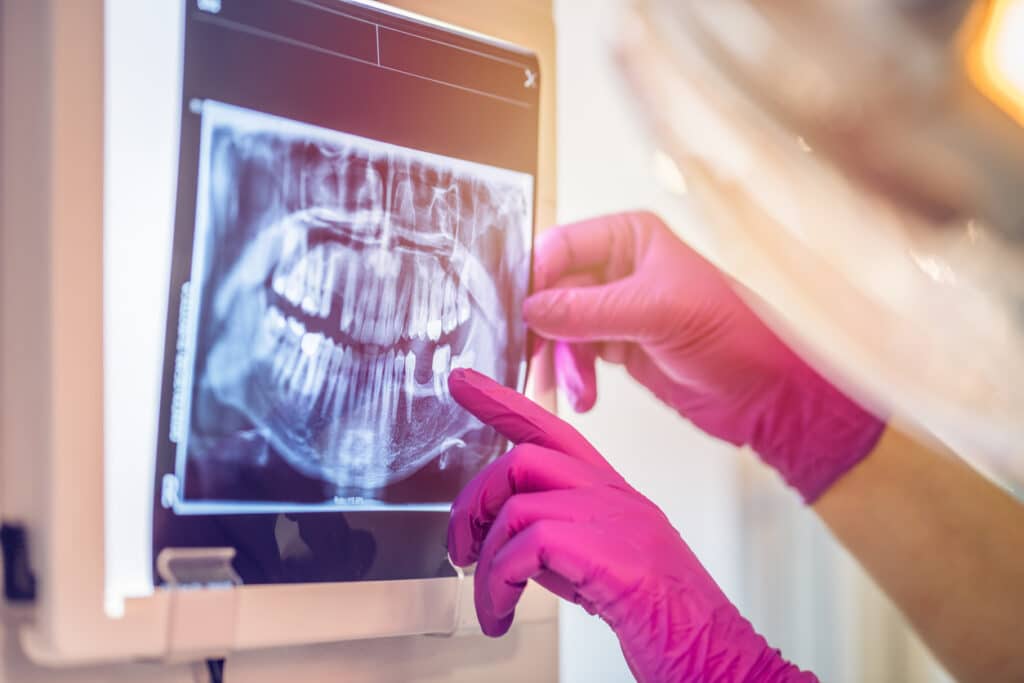
Dental X-Rays at Goldsboro Family Dental are imaging methods included in your professional teeth cleaning to uncover hidden decay, bone loss, and root infections. Clinical literature supports that dental X-ray images are essential for evaluation and therapeutic planning since many disorders cannot be easily evaluated by eye inspection [1] (Aljamal et al., 2025). This technology permits your dentist to see below your gums and enamel and identify microscopic problems before they become costly and painful dental emergencies.
How Often Do You Really Need X-Rays? Individualizing Your X-Ray Schedule
Many patients believe that dental X-rays are a one-size-fits-all requirement. In fact, current dental standards recommend a highly individualized approach. Your X-rays will be scheduled strictly based on your individual clinical risk factors. Clinical evidence indicates that X-ray procedures have become almost indispensable in dentistry, including for children and adolescents [2] (Hennig et al., 2023). If you are a “Preventive Planner” with a history of perfect checkups, healthy gums, and no recent cavities, you may only need bitewing X-rays every 18 to 24 months. However, if you have a high-sugar diet, a history of frequent decay, or active gum disease, we will likely recommend imaging every six to twelve months. During your cleaning, your hygienist and dentist evaluate your daily habits and past dental work to build an imaging schedule that safely protects your smile without overexposing you to routine imaging.
Pediatric X-Rays: Tracking Your Child’s Developing Smile
For the “Family CEO” managing schedules and pediatric appointments, understanding your child’s dental development is a top priority. Children’s mouths change rapidly. While a visual exam checks their visible baby teeth, X-rays are the only way to monitor the permanent teeth growing beneath their gumline. Medical evidence supports the pivotal role of radiological imaging in pediatric orthodontics, facilitating precise diagnosis, treatment planning, and monitoring of craniofacial anomalies and dental conditions [3] (Rafighi et al., 2024). Diagnostic imaging allows us to see if your child has missing adult teeth, extra teeth, or severe crowding before those issues cause physical pain. We can also track the position of incoming wisdom teeth as your teenager grows. By taking safe, low-radiation pediatric X-rays during their standard cleaning, we help you plan ahead for future orthodontic needs, keeping your family’s healthcare timeline completely predictable.
Comparing Your Diagnostic Options
Understanding the specific tools your dentist uses helps you take control of your healthcare. Here is a breakdown of the different diagnostic levels we use to protect your smile.
Diagnostic Method | Average Out-of-Pocket Cost | Primary Function | Maintenance Level & Frequency |
Visual Exam Only | $50 – $100 | Inspects visible surfaces, soft tissues, and gums for obvious decay or oral cancer. | Low (Performed at every 6-month cleaning visit). |
Bitewing X-Rays | $30 – $70 | Highlights cavities between back teeth and checks early bone loss. | Moderate (Typically taken once every 12 to 18 months). |
Panoramic X-Ray | $100 – $150 | Provides a full map of the jaw, evaluating wisdom teeth, jaw joints, and deep root cysts. | High (Taken as a baseline, then every 3 to 5 years). |
Beyond Cavities: Spotting Silent Cysts, Tumors, and Abscesses
When you think of dental X-rays, you probably think of tooth decay. But diagnostic imaging serves a much deeper medical purpose. It serves as a critical screening tool for hidden oral pathology with no physical symptoms. A chronic root infection (abscess) can grow silently at the base of your tooth for months before you feel a single twinge of pain. Furthermore, benign cysts or even early-stage oral tumors can form deep inside the jawbone. Your hygienist cannot see these serious threats during a routine polish. Digital X-rays illuminate the dark spaces within your bone tissue, catching these silent health threats early. Finding a small abscess on an X-ray today often means avoiding a complex surgical extraction tomorrow.
The Eco-Friendly and Time-Saving Perks of Digital Radiography
If you are a busy professional stepping away from work in Goldsboro, your time is extremely valuable. Older, traditional film X-rays required you to sit in the chair while a technician went into a darkroom, mixed chemicals, and waited for the film to develop. Instead, e use direct digital radiography to respect your time and the environment. Digital sensors capture high-definition images and project them onto a monitor right in front of you in seconds. There is no waiting, no darkroom, and zero toxic chemical waste entering our local water systems. You get to see exactly what your dentist sees instantly. This transparent, fast process gets you out of the dental chair and back to your busy day faster than ever.
Upgrading Your View: When We Use 3D CBCT Imaging
While standard 2D bitewing X-rays are perfect for your routine biannual cleanings, some smiles require a closer look. For advanced cases, Goldsboro Family Dental utilizes 3D Cone Beam Computed Tomography (CBCT). Unlike a flat 2D picture, a CBCT scanner rotates around your head to create a highly detailed, 3D model of your entire skull, jaw, and nerve pathways. We typically reserve this advanced imaging for specific situations, such as planning a precise dental implant, evaluating a painful TMJ joint, or navigating a complex root canal. If your standard cleaning reveals a complicated issue, you do not have to drive to a distant specialist. We have the advanced 3D technology right here to map out your treatment with perfect precision.
FAQs
1. Can I decline X-rays at my dental cleaning appointment?
While you have the right to refuse any treatment, dentists cannot properly diagnose your health without current X-rays. Refusing diagnostic imaging forces your dentist to perform a “blind” exam, which means they cannot guarantee your teeth are free from hidden decay or bone infections.
2. Are digital dental X-rays safe for children and pregnant women?
Yes, they are exceptionally safe. Digital X-rays emit a fraction of the radiation compared to traditional film X-rays less than you absorb from a short airplane flight. If you are pregnant, the American Dental Association confirms that routine dental X-rays are safe, though we will always provide a lead apron and thyroid collar for absolute protection.
3. Why do I need new X-rays if my teeth do not hurt?
Dental pain is a late-stage symptom. By the time a tooth physically hurts, the decay has likely reached the sensitive nerve center of your tooth. X-rays detect the earliest stages of demineralization, allowing us to treat the issue with a simple, painless filling before you ever feel an ache.
References
[1] Aljamal, M., Batakat, T., Hamd, Z., Abuzaid, M., & Gareeballah, A. (2025). Evaluating radiation safety knowledge and practices in dental professionals: findings from a cross-sectional survey. BMC medical education, 25(1), 973. https://doi.org/10.1186/s12909-025-07554-4
[2] Hennig, C. L., Schüler, I. M., Scherbaum, R., Buschek, R., Scheithauer, M., Jacobs, C., & Mentzel, H. J. (2023). Frequency of Dental X-ray Diagnostics in Children and Adolescents: What Is the Radiation Exposure?. Diagnostics (Basel, Switzerland), 13(3), 394. https://doi.org/10.3390/diagnostics13030394
[3] Rafighi, A., Jahanbani, M., & Mahmoudi Anzabi, R. (2024). A Critical Review of the Efficacy and Safety of Radiological Imaging Techniques in Pediatric Orthodontics. Galen medical journal, 13(S Pt 1), e3698. https://doi.org/10.31661/gmj.v13iSP1.3698