
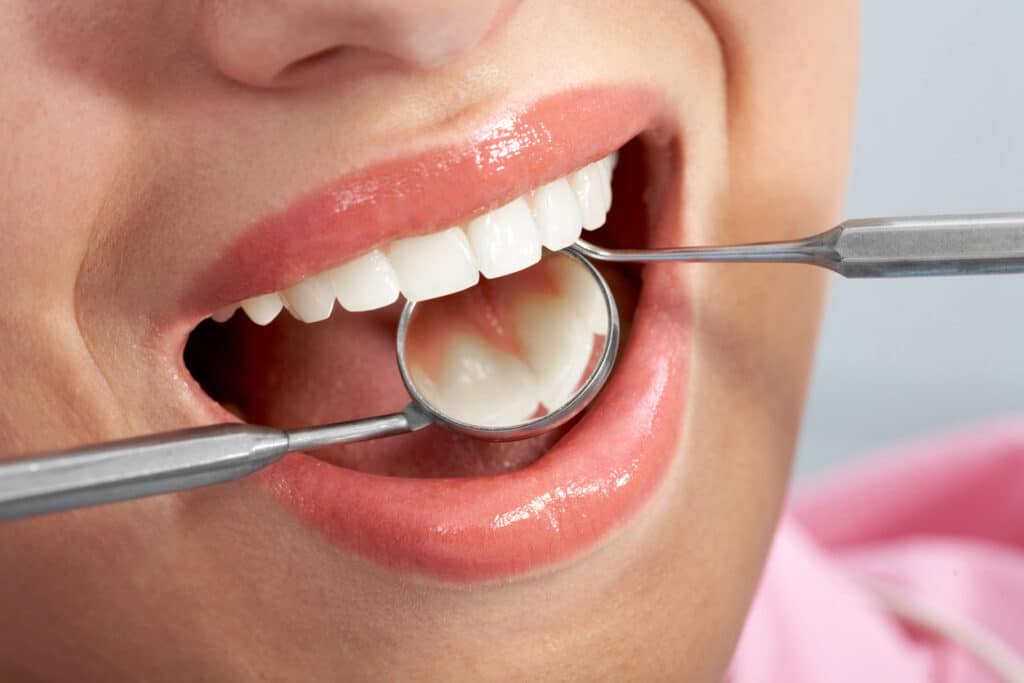
At Goldsboro Family Dental, tartar can only be safely removed by a professional dental cleaning. This process is called scaling. Tartar (or dental calculus) is plaque that’s hardened and firmly attached to your tooth enamel. Additionally, clinical literature supports that the failure to remove calculus or tartar from dentition can result in periodontitis [1] (Wei et al., 2024). This hardened bond cannot be removed with ordinary toothbrushes; dental professionals use special ultrasonic devices to gently dissolve the buildup and remove it.
Why Do Some People Build Up Tartar Faster Than Others?
You might brush twice a day, floss faithfully, and still notice hard buildup on your lower teeth. Medical literature indicates that when plaque biofilm is allowed to grow undisturbed, the degenerating bacteria in a climax community may act as seeding agents of mineralization [2] (Samaranayake et al., 2017). This can feel very frustrating, but it is rarely your fault. Tartar formation relies heavily on the unique chemistry of your saliva. Your saliva contains minerals like calcium and phosphate, which help protect your teeth. However, if your saliva has a higher mineral concentration or a higher pH level, plaque hardens into tartar much faster. Furthermore, conditions that cause dry mouth reduce your natural saliva flow. Without enough liquid to wash away food particles, bacteria thrive and calcify rapidly.
Three Silent Signs You Have Hidden Tartar Buildup
You can often feel supragingival tartar (buildup above the gums) with your tongue. It feels like a rough, cement-like ledge behind your bottom front teeth. Medical evidence indicates that the severity of periodontitis correlates with halitosis and oral hygiene, as reflected in plaque and calculus indices [3] (Music et al., 2021). But subgingival tartar (buildup below the gums) is invisible to the naked eye. To protect your smile, you need to watch for three silent warning signs:
- Chronic Bad Breath: Tartar is highly porous. It acts as a permanent sponge that traps odor-causing bacteria. If your bad breath returns just minutes after brushing, hidden tartar is likely the culprit.
- Bleeding When Flossing: Healthy gums do not bleed. If you spit pink in the sink, your gums are actively inflamed by calcified bacteria resting beneath the surface.
- A “Heavy” Feeling in Your Gums: As tartar grows below the gumline, it creates physical pressure. You might notice a dull, swollen, or heavy sensation spreading across your gum tissue.
Comparing Tartar Buildup Levels
The exact treatment you need depends on how far the tartar has progressed. Here is a breakdown of how we treat different stages of buildup.
Buildup Level | Pathology Description | Required Treatment | Out-of-Pocket Cost Factor | Maintenance Level |
Soft Plaque | Sticky bacterial film easily removed at home. | Daily brushing and flossing. | $0 (Free at home) | High (Requires daily effort) |
Supragingival Tartar | Hardened buildup visible above the gumline. | Routine Cleaning (Prophylaxis) | Low ($100 – $150 without insurance) | Biannual visits (Every 6 months) |
Subgingival Tartar | Deep, calcified buildup hiding below the gums. | Deep Cleaning (Scaling & Root Planing) | Moderate ($200 – $350 per quadrant) | Frequent visits (Every 3 to 4 months) |
The Hidden Dangers of Subgingival Tartar (Below the Gumline)
Visible tartar on your teeth is a cosmetic nuisance, but hidden tartar below your gums is a serious medical issue. When plaque hardens beneath the soft tissue, it creates a wedge between your tooth root and your gums. This wedge forces your gums to pull away, creating deep spaces known as periodontal pockets. As these pockets grow deeper, more bacteria fill in. Because your toothbrush bristles cannot reach below the gumline, the infection spreads to your jawbone. If left untreated, this process destroys the bone holding your teeth in place, eventually causing tooth mobility and tooth loss. Removing subgingival tartar promptly stops this destructive cycle and allows your gums to reattach firmly to the tooth.
Does Removing Tartar Damage Your Enamel?
A very common patient fear is that the sharp scaling tools will accidentally scratch or wear away healthy tooth enamel. However, your enamel is the hardest substance in the human body—even harder than bone. Tartar, on the other hand, is much softer and more brittle than your natural teeth. Our specialized ultrasonic scalers are precisely calibrated to shatter the brittle tartar bonds without scratching the durable enamel underneath. Your dental hygienist is highly trained to apply the exact amount of gentle pressure needed. After the buildup breaks away, we polish the surface. Your teeth will not be weakened; they will actually be stronger and much easier to clean at home.
Post-Removal Care: How to Keep Your Smile Smooth
Walking out of our Goldsboro clinic with perfectly smooth, glass-like teeth is a great feeling. To extend that fresh feeling and slow down future buildup, you need a targeted daily routine. First, switch to a soft-bristled electric toothbrush. The rapid micro-vibrations break up sticky plaque far more effectively than a manual brush, stopping the 48-hour calcification clock. Second, look for a toothpaste containing “pyrophosphates.” This specific ingredient actively prevents the minerals in your saliva from bonding to the plaque. Finally, stay hydrated with plain water throughout the day. Water naturally neutralizes the acid in your mouth and washes away lingering food debris, making it much harder for stubborn tartar to take root.
FAQs
1. Can I safely scrape off tartar at home?
No. You should never use store-bought metal picks or sharp tools to scrape your own teeth. Because tartar bonds so tightly to the tooth, DIY scraping often results in scratched enamel, permanently damaged gums, and expensive restorative dental bills. Always leave tartar removal to a licensed professional.
2. How fast does plaque turn into tartar?
Plaque begins to calcify and turn into tartar in as little as 24 to 72 hours. This is why brushing twice a day and flossing at least once a day is critical. Once the 72-hour window passes, any missed plaque will likely require professional removal.
3. Will my teeth feel sensitive or loose after tartar is removed?
If you had a heavy amount of tartar, your teeth might feel slightly sensitive to cold air or beverages for a day or two. Heavy tartar acts like an unnatural “blanket” over the teeth. Once removed, your enamel needs a brief moment to adjust to its clean, natural state.
References
[1] Wei, Y., Dang, G. P., Ren, Z. Y., Wan, M. C., Wang, C. Y., Li, H. B., Zhang, T., Tay, F. R., & Niu, L. N. (2024). Recent advances in the pathogenesis and prevention strategies of dental calculus. NPJ biofilms and microbiomes, 10(1), 56. https://doi.org/10.1038/s41522-024-00529-1
[2] 2017, Dental Clinics of North America Lakshman Samaranayake DSc, DDS, FRCPath, FDSRCS, FDSRCPS, FRACDS, Victor H. Matsubara PhD, DDS, MSc
[3] Musić, L., Par, M., Peručić, J., Badovinac, A., Plančak, D., & Puhar, I. (2021). Relationship Between Halitosis and Periodontitis: a Pilot Study. Acta stomatologica Croatica, 55(2), 198–206. https://doi.org/10.15644/asc55/2/9