
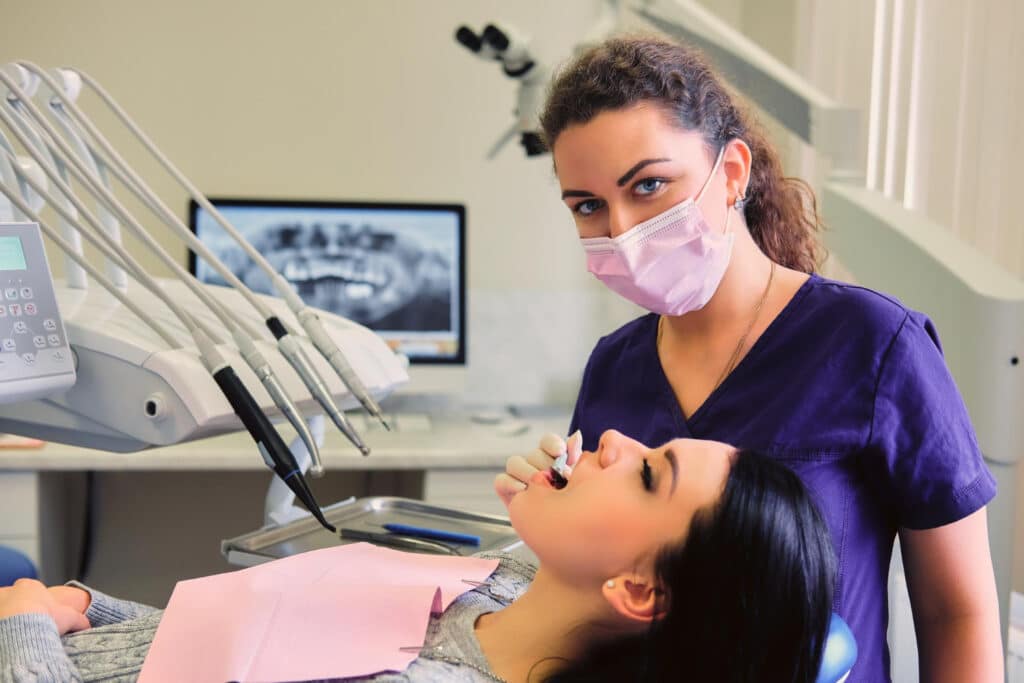
Clinical literature defines postoperative hypersensitivity as tooth pain with mastication or sensitivity to hot, cold, and sweet stimuli that occurs a week or more after the tooth restoration [1] (Berkowitz et al., 2013). Mild discomfort to hot, cold, or biting pressure usually occurs with normal healing and adaptation of the nerve in the tooth within two to four weeks.
The Dental Bond: What Science Says About Your Tooth Feeling Different
Beneath the hard, outer layer of your teeth is a softer layer called dentin. Dentin has thousands of little tubes that go straight to the nerve center of your tooth. Medical evidence shows that the dentin layer makes up most of the tooth’s mineralized tissue [2] (Goldberg et al., 2011). When our team at Goldsboro Family Dental removes an active cavity, these tiny tubes are temporarily exposed. We use a high-tech bonding liquid to seal them before placing your composite filling. However, this fluid needs a little time to fully cure and block nerve signals. Until the seal completely stabilizes, hot and cold sensations can travel down those microscopic tubes and trigger a quick flash of sensitivity.
Dietary Tweaks to Speed Up Your Nerve Recovery
What you eat in the days following your procedure directly impacts how fast your tooth heals. To give your irritated nerve a break, avoid temperature extremes. Skip the iced coffee and steaming hot soups for at least 48 hours. Furthermore, stay away from highly acidic foods like citrus fruits, tomatoes, and soda. Acid can easily aggravate a tooth that is already experiencing an inflammatory response. Clinical evidence indicates that contact time between the teeth and acid can be an important risk factor for dentine hypersensitivity [3] (O’Toole et al., 2017). Stick to a neutral, room-temperature diet. Soft foods like yogurt, scrambled eggs, and protein shakes keep your healing tooth comfortable.
Treatment Comparisons: Why Does Your Tooth Still Hurt?
Sometimes, your tooth needs a little extra help to feel normal again. If your pain does not follow the standard healing timeline, your dentist will evaluate you for one of these specific solutions.
Condition & Treatment Type | Out-of-Pocket Cost Estimate | Solution Durability | Maintenance Level |
Normal Healing (Wait & See) | $0 (At-home care) | Permanent once the nerve calms down. | Low (Use sensitive-teeth toothpaste for a few weeks). |
High Bite (Bite Adjustment) | Usually Free (If done shortly after the initial filling). | Permanent (Reshapes the filling to match your natural bite). | Low (Standard daily brushing and flossing). |
Deep Infection (Root Canal Therapy) | $800 – $1,500 (Varies by tooth and insurance coverage). | Long-term (Saves the natural tooth from extraction). | Moderate (Requires a permanent dental crown to protect the tooth). |
Referred Pain: Why the Wrong Tooth Might Feel Sore
You had a cavity filled on your upper right side, but now your lower right jaw aches. This confusing sensation is a documented medical phenomenon called referred pain. All the teeth in one quadrant of your mouth share the same main nerve pathway to your brain. When a freshly filled tooth sends strong pain signals, your brain sometimes struggles to pinpoint the exact source. As a result, the healthy teeth next to your filling, or even the teeth directly below it, might throb. Once the treated tooth calms down, this mysterious phantom pain will vanish on its own.
Clenching and Grinding: The Hidden Cause of Prolonged Soreness
Daily stress often makes you clench or grind your teeth while you sleep. If you grind your teeth at night, you put heavy, persistent pressure on your newly placed filling. A tooth recovering from a dental drill is already in a sensitive state. The added force of nighttime grinding prevents the delicate ligament surrounding your tooth root from resting. If you wake up with a dull ache that slowly fades by the afternoon, nighttime grinding is likely the culprit. Mention this to your dentist, as a custom night guard can protect your fresh dental work and speed up your recovery.
How Early Cavity Detection Stops Sensitivity Before It Starts
The depth of your cavity determines exactly how much sensitivity you will experience. A shallow cavity sits far away from your nerve. When we fix a small cavity, you rarely feel any discomfort afterward. Conversely, if decay reaches deep into your tooth, the repair process sits dangerously close to the pulp. This deep work always triggers a much stronger inflammatory response. By keeping up with your routine digital X-rays at Goldsboro Family Dental, we spot decay while it is still tiny. Catching cavities early means shorter appointments, lower costs, and a practically painless recovery.
FAQs
1. How long will my tooth be sensitive to cold after a filling?
It is completely normal for a tooth to react to cold drinks for two to four weeks after a new composite filling. As long as the sharp feeling disappears quickly after you swallow the cold drink, your tooth is healing properly.
2. Can a high bite cause tooth pain?
Yes. If your filling is even a fraction of a millimeter too high, that single tooth bears the brunt of your jaw’s biting force. This causes inflammation in the periodontal ligament, leading to significant soreness. A fast adjustment by your dentist solves this instantly.
3. When should I call the dentist about post-filling pain?
You should call us if your pain wakes you up from sleep, if the tooth throbs constantly without any hot or cold triggers, or if over-the-counter medication does not provide relief. These are signs of an irritated nerve that requires professional attention.
References
[1] Berkowitz, G., Spielman, H., Matthews, A., Vena, D., Craig, R., Curro, F., & Thompson, V. (2013). Postoperative hypersensitivity and its relationship to preparation variables in Class I resin-based composite restorations: findings from the practitioners engaged in applied research and learning (PEARL) Network. Part 1. Compendium of continuing education in dentistry (Jamesburg, N.J. : 1995), 34(3), e44–e52.
[2] Goldberg, M., Kulkarni, A. B., Young, M., & Boskey, A. (2011). Dentin: structure, composition and mineralization. Frontiers in bioscience (Elite edition), 3(2), 711–735. https://doi.org/10.2741/e281
[3] O’Toole S, Bartlett D. The relationship between dentine hypersensitivity, dietary acid intake and erosive tooth wear. J Dent. 2017;67:84-87. doi:10.1016/j.jdent.2017.10.002